New York Theater Review
Kodi Lynn Milburn on Bazeed & Shadi Ghaheri’s faggy faafi Cairo boy
as presented by National Queer Theater and HERE arts as part of Criminal Queerness Festival
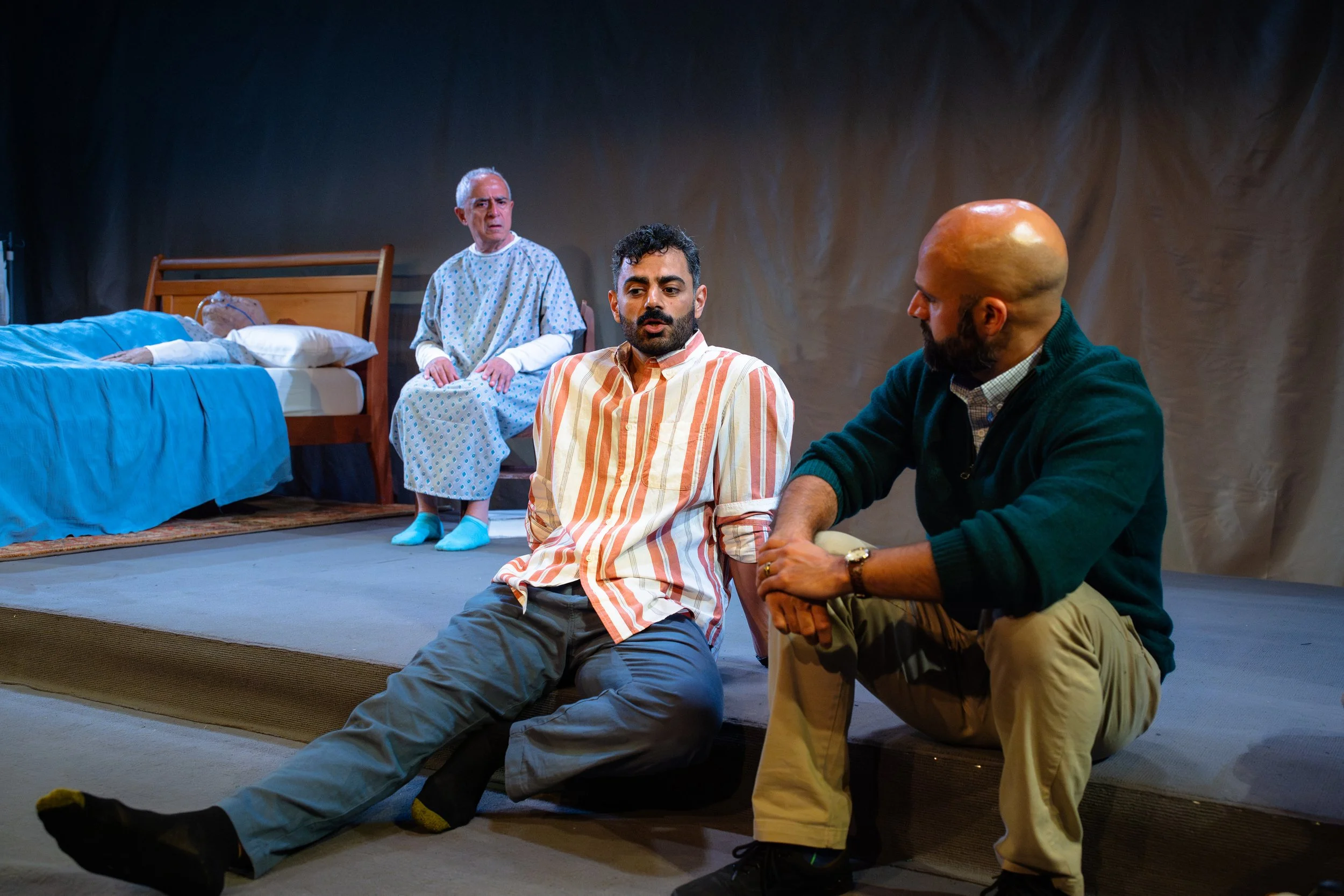
Pictured (LtoR): Anton Obeid, George Shakkour, and Hassan Nazari-Robati. Photo by HanJie Chow.
When you walk in and Sherine is playing, you know it’s gonna be a good time. This multigenerational, multicultural, multidimensional play strikes a beautiful balance of comedy and layered trauma. The show moves seamlessly through grief for a dying parent, a lost relationship, and a life lived in fear. Bazeed’s faggy faafi Cairo Boy follows Mo (George Shakkour) as they navigate returning home to Cairo to be with their Baba (Anton Obeid) in their final moments while holding onto their relationship with American fiancé, Jacob (Jakeem Powell) and reckoning with their closeted love from high school, Yasser (Hassan Nazari-Robati). The plot thickens when a yassified angel of death, Angel G. (Jae W. B.), guides Baba from coma to death, from hate to acceptance.
Speaking about the play structurally and theatrically, there were elements that worked for me and some that didn’t. I loved the preshow speech. It was such a nice break from being taken out of the moment. It was funny, kept us in the vibe they curated when walking in, and it was voiced by the “angel” (Jae W.B.), which was a clever touch. There were moments in the play that had overlapping scenes between Mo and Yasser or Jacob while Baba and Angel G. spoke. As a playwright, I can appreciate that stylistic approach; however, I felt like I missed important information. Perhaps the intention was only to pick out certain lines, but I found it busy at times. I enjoyed this choice when lines were not on top of each other, but rather intertwined. Bazeed has a lush and poetic way of writing almost Shakespearean couplets for Angel G., and Jae W.B. ate up the language with masterful delivery and juicy inflection, perfuming the heightened aspect of the text with ease and style. Jae W.B. stole the show for me — so funny, witty, and never one-note.
Speaking on the theatrical vehicles, the stage was split into two play spaces. The main stage had a projection screen with a bed, and on stage right, a green screen with apple boxes. From the green screen zone, scenes were played out and live streamed to the projector on the main space. This was a rather ambitious choice by projection designer Gavin Strawnato. I thought it was interesting at first, but then I found myself not wanting to see how the sauce was made, so to speak. Putting the green screen behind a curtain or just watching the very talented actors and powerful direction by Shadi Ghaheri stand on its own would have been my choice. I find the use of live feed in theater to be overdone, and it was splotchy at moments when actor Jakeem Powell was delivering truly moving monologues and scenes. Design should be in service of the story, not a cool trick, and this element took me out of the moment. Technically speaking, it also tied the hands of the lighting team. A green screen requires bright light, but a projection screen cannot have too much light pollution for images and text to be legible. The moments without use of the live feed had stunning and emotionally evocative lights by Maryam Sweirki. I actually enjoyed many of the (non-live-feed) projections when they moved in tandem with the plot or with other design elements in mind, especially the ones featuring the Queen Boat incident. I didn’t know about this historical event before seeing the show, and I was interested to learn this piece of Queer history and resistance. Addressing the sound design by Jeremy Kadetsky and Lola Basiliere, I felt the music choices were superbly aligned with the text, marrying queer beats with Arabic pop and atmospheric underscoring that was evocative of Egypt without being cliché. I thought the sharp cuts into scenes were nice and whoever was board operating had impeccable timing. Personally, I am not a fan of going dark for a scene change. I would have liked to see these shifts happen stylistically or have tech visually support the change so we didn't feel like we just paused the story. The costumes by Jasmine Canjura and Mireya Velasquez for Angel G. were *chef’s kiss*. Forest Entsminger was able to capture a beautiful scenic element in a sugar cane field scene. Lighting and Scenic departments worked together for this flashback moment in the fields, and the design support elevated an already gut-wrenching and heartfelt monologue by George Shakkour. Shakkour moved through scene and space skillfully and with a gentle touch.
I feel the play covered a lot of ground in terms of themes — queerness, self-love, cultural identity, leaving religion and its pressures, blood family vs. chosen family, death, and resistance. There was a line in the show I’m paraphrasing, but I walked away moved by it — “there is comedy to heal and comedy that makes you bitter.” Being queer myself, lgbtqia2s+ people have this resilience in comedy; however, it can be a defense for some deep-rooted trauma. I felt seen by the naming of this pain. Anton Obeid as Baba deserves a standing ovation for the performance delivered. Obeid’s tender moments met with rage at their son’s identity, giving a performance rounded out with comedy and fear of what lies beyond death. A lot was demanded of this character, and Anton’s work should be celebrated. Hassan Nazari-Robati’s character, Yasser, struck me as a parallel to Mo’s Baba. Hassan did a fantastic job of embodying internalized homophobia, delivering a cutting yet nuanced performance. Jakeem Powell was loveable and complex, and I found myself rooting for them as if they were the primary protagonist of the story. I really enjoyed that this show did not wrap up all of the story lines with a bow. Bazeem left us in the gray area, and such is life.
National Queer Theater and HERE arts as part of Criminal Queerness Festival present
faggy faafi Cairo boy
Written by Bazeed
Directed by Shadi Ghaheri
Featuring:
Hassan Nazari-Robati* as Yasser
Anton Obeid* as Baba
Jakeem Powell* as Jacob
George Shakkour as Mo
Jae W.B.* as Angel G.
Creative Team:
Nat Kelley DiMario* (Stage Manager)
Dmitri Barcomi (Production Manager)
Anushka Srivastava (Production Assistant)
Forest Entsminger (Props/Scenic Designer)
Maryam Sweirki (Lighting Designer)
Jeremy Kadetsky (Sound Designer)
Lola Basiliere (Assoc. Sound Designer)
Jasmine Canjura (Costume Designer)
Mireya Velasquez (Assist. Costume Designer)
Dezi Tibbs (Dramaturg)
Gavin Strawnato (Video Designer)
Peter Dunn (Casting Director)
Sean Griffin (Fight/Intimacy Coordinator)
Desmond Picotte (Promotional Photographer)
*Denotes Actors’ Equity Association (AEA) member
Kodi Lynn Milburn on Kona Morris’ & Padriac Lillis’ How to Poop in an Outhouse at -72°F
as presented by New York Fringe Festival at Under St. Marks

photo by Joshua Wachs
Fringe is a platform for staging productions that work well in unconventional spaces and with intimate, up close audiences. I have a special place in my heart for the beauty of fringe. I find that stripping back a show's ability to hide behind spectacle, allows for out of the box thinking and creative problem solving. Fringe allows the story and storyteller to take center stage. This simplicity often makes room for stories to reach audiences that may not have otherwise been heard. That being said this show hit the mark in some ways and missed in others.
This solo show follows the writer/performer, Kona Morris’ personal experience living in Alaska immersed in an indigenous community, marrying a native man, and giving birth to a mixed indigenous child. Ultimately, Kona returns to the lower states, but the majority of the story takes place in the village of Gwichyaa Zheh (also known by its colonial name, Fort Yukon). Morris does a beautiful job of being present with the audience.
The story touches upon the struggles of deciding to become a parent — that balancing act of wanting youth and freedom vs. community and roots. Speaking as a cis woman who is able to have children (but having none myself), I found the conversation surrounding abortion and reproductive health care in America compelling. Morris’ comments about the struggles to find access to healthcare or abortion for birthing people in such a remote location highlighted a point of intersectionality that is rarely spoken about. I appreciated the raw and open approach to their experience and the, by no means simple, journey to deciding to have the child. The show explored the very real fear of bringing a baby into the world given the political climate of the early 2000s. Horrifyingly, those fears resonated firmly with issues today.
Speaking as a designer, I enjoyed the use of color during a lovely description of the northern lights. Designer Matthew Hallock’s use of moving lights and gobos gave great texture and, when used, helped immerse us further into the plot. The use of voice over, voiced by Kaihinjik Alexander, was a hilarious and nice change of pace, though used sparingly. Adding more voice over could have given the team an opportunity to bring in more collaborators from the community they’re speaking on, giving them a seat at the creative table. There were also a few climactic moments in the piece that could have been supported with sound design to help root the stakes of the moment in tandem with the acting. Riding in a bush plane and canoeing down a river are great canvases for more design elements.
Speaking from an indigenous perspective myself (Tsalagi, Eastern Band, Wolf Clan, & Czech), I personally had some issues with the piece. We’re not a monolith, so other natives may not have taken issue, but I found myself uncomfortable when the main character spoke in a fake native accent. I also found myself wondering why there were traditional seal skin gloves and beadwork on the wall as, at best, decoration with no acknowledgment of their cultural significance and without using them at all. I felt some of the descriptions of the performer’s experiences teetered between eroticism and genuine curiosity, wonder, or respect. There were many moments when real issues facing First Nations could have been discussed but were skimmed over. For example, the title: the crux of the joke was about having to use an outhouse because there was no running water or indoor plumbing, but WHY does this community lack these resources? Not having basic needs in remote areas or on reservations is a huge issue and not delving deeper into the causes makes natives’ lack of access the butt of the joke (pun intended). It’s not for lack of innovation; it’s because of the manufactured poverty and subjugation of native populations by the American government — this should be named. Additionally, the performer mentioned working at a grocery store, but ignored that one of the biggest issues facing Native Alaskans is the price of food and how big companies exploit the lack of options by price gouging. There was talk of fishing and traditional practices, but no acknowledgement of climate impact, overfishing by corporations, or laws against traditional practices being enforced as late as the 70s.
Natives are masterful comedians and can take a joke, often using humor as a coping mechanism, but without cultural, historical, or political context, we become the joke. Using native stories with little context to the why, or without a call to action, feels like a performative land acknowledgment.
There were two moments that I felt were done well, culturally speaking. The first was a comment regarding how a lot of young girls in the tribe would become pregnant and then drop out of school. When it is first mentioned, the tone is purposely judgemental. Later, Kona acknowledges the lack of reproductive care and that people in the tribe were bringing babies into a beautiful and thriving environment, rich with community. The second moment involves the beautiful name of their child being the first name in their native tongue on a birth certificate in 30 years. The erasure of language is a huge issue, and what the story lacked was the WHY. Is it because native languages are banned from use or systematically destroyed in residential schools? I think if you’re going to tell native stories as a non-native person, it’s a fine line between appreciation and using native stories as an interesting prop. I’m sure that wasn’t the intention, but in 2026 we need to go beyond intention and consider impact. I think the show had some beautiful notes of growth. I appreciated the effort to include language while speaking on the warm and welcoming community. I wish there was a native director or consultant on the team.
I understand too that we cannot touch on all the issues, that some moments in life aren’t that serious, that this is Morris’ story from Morris’ perspective, but representation in the arts for indigenous people is so scarce and often our stories are told without us there.
Produced by Joshua Wachs, Pickles and Cheese Productions, New York Fringe Festival, and Under St. Marks present
"How to Poop in an Outhouse at -72°F"
Written and Performed by Kona Morris
Directed by Padraic Lillis
Lighting Design by Matthew Hallock
Voice Over by Kaihinjik Alexander
Kodi Lynn Milburn on Carolina Ðỗ & Vas Eli’s EXTRAO1DINARY ALIENS!
as presented by JACK
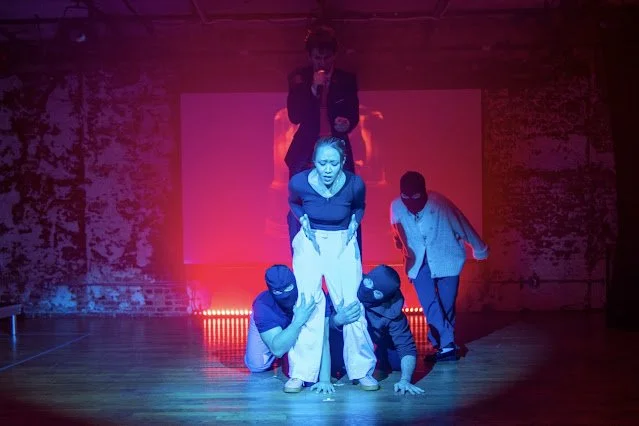
Photo by Tudor Cucu
It’s not often a show allows you to take what you’re witnessing outside the theater and bring it in without being asked to leave it at the door to escape. While I was watching Extra01dinary Aliens!, the voice of a protester in Minneapolis warning of ICE in the area echoed through my mind: “Stay inside! They’re here!” The lady in the polka dot dress in NYC; Alysa Liu dedicating her gold medal to her immigrant father — this play is incredibly timely, even down to the curated preshow playlist including “Stateside” (Pink Pantheress and Zara Lawson’s song to which Alysa Liu skated when taking home the gold for the U.S.). This play does not ask you to put on blinders to enjoy a laugh or be embraced into the community. This company and the theater that houses it don’t shy away from the here and now in America. Instead, they offer free “ICE Out” classes, a financial literacy course, and “Know Your Rights” workshops to their audiences. I love action-driven theater.
This piece is a vibrant, gutting, and surprisingly hilarious “fuck you” to the immigration systems in America. It’s a warm embrace of familiar lived experience for those victimized by it. As a descendant of Native Americans (Tsalagi, Eastern Band, Wolf Clan) and Czech immigrants, both sides of my ancestry felt seen. The irony of the descendants of European colonizers (only a few generations removed) now policing occupied lands was not lost on writer Carolina Ðỗ. The inclusion of historical revisionism and a well-designed projection of Manifest Destiny by projection designer Michi Zayamade me want to scream “No one is illegal on stolen land!” in solidarity.
The story follows a wide range of immigrant stories highlighting the spectrum of experiences, including an alien from Pluto visiting America — a clever jab at the dehumanizing term “alien”. The fantastic cast spoke to their personal lived experience through the characters. Their authenticity anchored the otherworldly and sometimes whacky aspects of the play. Vas Eli (director, actor, and sound designer) delivers a raw and moving scene with impassioned and evocative scene partner Julie Tran, in which a couple grapples with their very real love being tainted by the ever-present eye of the U.S. immigration system. Love has no borders. Matthew Zimmerman plays the omnipresent voice of USCIS that is satirical, horrifying, and even predatory. Zimmerman shows great range in this portrayal, spanning from righteous to diabolical. Belle Le and Marlon Xavier’s scenes together were touching and organic, presenting a beautifully grounded example of budding love complicated by immigration status. Neither of them have “papers” and they ask “what if we have kids and we get separated?" The two actors held the weight of these themes with grace and soft humor. Maria Müller plays multiple roles, including the Plutonian, making a role that could be silly into a thoughtful masterclass on satire. Müller is snappy and witty, skillfully buttoning scenes with impeccable comedic timing.
The use of gobo and emotionally evocative lighting by Jiahao “Neil” Qiu amplified the moments about love and fear very well. As a sound/projection/lighting designer myself, I particularly enjoyed the use of practicals on stage, lights emanating from unseen sources and vocoders masking the voice. Vas Eli’s use of musical detournement was brilliant and evoked a poem I heard recently by Hayley DeRoche in which she hijacks and reconstructs a “Drive to Target” ad to emphasize the horror of ICE and the ever-present American brand consumerism. One prop and set application that stood out to me as particularly impactful was Joaquim Stevenson-Rodriguez’s moon design.
All in all, I think the show technically could use some tightening up. There were a few missed language translation cues and some that gave away plot before it happened. That being said, the team recovered beautifully, and the actors were unphased. None of this took away from the enjoyment I felt while watching this piece. Personally, I am not a fan of excessive use of haze and the show uses a lot of it as well as real smoke. Just a heads up for those who may have asthma. The satirical gameshow vibe really drove home the inhumane moving goal posts and dehumanization that immigrants coming to this country must feel. I left the theater with more fuel and desire to abolish ICE.
BETTERFLY Productions, Leviathan Lab, and JACK present;
EXTRAO1DINARY ALIENS!
in association with
The Hearth Supported Productions and The Sống Collective
Written by Carolina Ðỗ
Directed by Vas Eli
Co-produced by Maria Müller
Line produced by Federica Borlenghi
Assistant Directed and Stage Managed by Isabel Criado
Lighting Design by Jiahao “Neil” Qiu
Projection Design by Michi Zaya
Sound Design by Vas Eli
Moon Design by Joaquim Stevenson-Rodriguez
Board Operated by Fernando Gregório
CAST
Corneliu - Vas Eli
Kay - Julie Tran*
Xerxes - Maria Müller
Linh - Belle Le
David - Marlon Xavier
Voice - Matthew Zimmerman*